Collin County
Electrician in New Hope, TX
Licensed & insured electrical work for New Hope, TX homeowners — panel upgrades, EV chargers, lighting, generators, and repairs from a local, owner-operated team.
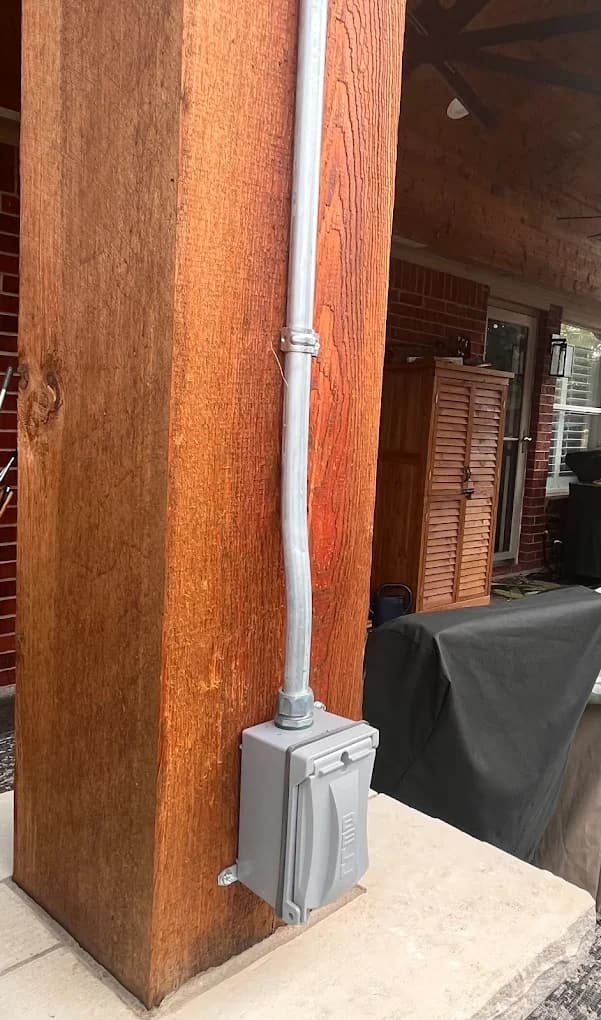
New Hope is the smallest place we cover, and it is one of the few where the right electrical answer is genuinely different from the answer three miles west in McKinney. The town had 661 residents at the 2020 census on a footprint of under two square miles, and it is run as a general-law Class B town with a mayor and five aldermen rather than a city hall with departments.
The Town's own history page describes New Hope as an incorporated suburban community three miles east of McKinney in central Collin County, established in the early 1850s as a school and church community for area farmers and originally incorporated in 1974. The population series on that page is the clearest picture of the place: under 100 residents until the mid-1960s, 250 in 1970, 331 in 1980, 523 in 1990. Census figures since then read 662 in 2000, 614 in 2010 and 661 in 2020. Almost all of the growth happened in a thirty-year window, and almost none of it has happened since.
Tamenator Electrical Services is based in Celina, and owner Tamen Privratsky has worked as a licensed electrician across North Texas for over 13 years. Three things make a New Hope job different from a McKinney subdivision job, and all three change what we do before anyone touches a wire: the power comes from a rural electric cooperative rather than the retail-choice market, there is no municipal sewer so the property is almost certainly on an on-site septic system with its own electrical rules, and permitting runs through one Building Official rather than a portal.
Your Power Comes From a Cooperative, Not Oncor
This is the fact worth knowing before you call anyone. Most of the cities we serve are Oncor territory in the Texas retail-choice market, where one company owns the poles and a different company sends the bill. New Hope is not one of them.
The Town's own utility services sheet lists exactly one electric provider for residents: Grayson Collin Electric Cooperative, Inc., at 14568 FM 121 in Van Alstyne, reachable at 903-482-7100 or 800-967-5235. The same sheet lists North Collin Special Utility District for water and three private haulers for trash. There is no wastewater utility on it at all.
GCEC is a non-profit rural electric utility cooperative headquartered in Van Alstyne serving the rural portions of Grayson and Collin counties, and it was organized in 1937 - founded in September 1937 and incorporated that same month at a bank in Van Alstyne. It owns the lines and it signs up the member. Its start-service page asks for 5 to 7 business days' notice, a refundable $20 membership fee, a $35 transfer or reconnect service fee and a $10 credit-check fee. If you moved here from a Power to Choose address in Plano or McKinney, that is the practical difference: you are a member of the cooperative, not a customer shopping retail plans.
For routine work - a fixture, a circuit, a troubleshooting call - none of this matters. It matters enormously on any job that requires the meter to be pulled: an electrical panel upgrade, a meter base or service mast replacement, a service relocation. The cooperative schedules the disconnect and the reconnect on its own terms, and that schedule drives your calendar, not the other way around. We confirm who owns the drop at your address and book the sequence - disconnect, work, inspection, reconnect - before a date is promised.
It is worth confirming your specific address rather than assuming, because utility boundaries out here do not follow town lines. Princeton, the next town east, has three different electric utilities serving addresses inside one city, GCEC among them.
Permits Run Through One Building Official
A town of 661 people does not staff a development services department, and New Hope does not pretend to. Permitting runs on PDF forms and two email addresses: the permits and zoning page lists a Building Official at buildingofficial@newhopetx.gov and the Town Secretary at secretary@newhopetx.gov. Town Hall is at 121 Rockcrest Road and the number is 972-548-2489.
Electrical is one of the trade permits the Town issues. The current comprehensive fee schedule, version 12 dated February 24, 2026, sets trade permits for alterations, additions and improvements to residential construction at a base fee of $110.00 plus $110.00 per trade, capped at $440.00. Project types not listed are $176.00 per trade, solar panels are $176.00, plan review only on a residential dwelling runs $165 to $220 per plan or address, manufactured homes are $440.00, and a certificate of occupancy applies to commercial properties only at $85.00.
The line that costs people money is the late fee. The Town's building permit instructions state that late fees for obtaining permits or inspections after work has commenced are calculated at two times the applicable fee. Unpermitted electrical work discovered after the fact in New Hope does not just get corrected - it gets corrected and doubled.
For new residential construction the Town's instruction sheet sets a specific order: obtain the county septic permit first, because a building permit will not be approved without it; submit two sets of plans that must include electrical plans; and allow ten days for the Building Inspector to confirm the approved permit is ready. There is no same-day counter here.
One detail to raise with the Building Official rather than assume. The permits page states that the Town has adopted the 2021 International Building Code under Ordinance 2023-005, but it does not publish an adopted edition of the National Electrical Code, and the older permit application form on the Town's site still references 2006-era codes. The statewide floor is clear regardless: the Texas Department of Licensing and Regulation adopted the 2023 NEC effective September 1, 2023 and has since adopted the 2026 NEC as the state electrical code, with a limited exception for ground-fault protection on certain outdoor outlets, effective September 1, 2026. We confirm the edition the inspector is holding at the time we pull the permit. For what an electrical inspection actually looks at, see do you need a permit to upgrade an electrical panel in Texas.
Septic Systems Have Their Own Electrical Rules
There is no sewer in New Hope. Wastewater is handled on each lot by an on-site sewage facility, and in Collin County those are permitted by Development Services at 4690 Community Ave. in McKinney, reachable at 972-548-5585 or developmentservices@collincountytx.gov, open 7:30 a.m. to 4 p.m. Monday through Friday. The county notes that its OSSF permits expire after 365 days with no activity, that it operates under a county court order with rules more stringent than the state rules, and that selling a property with an aerobic system requires three forms including a maintenance contract in the new owner's name.
What almost nobody tells a homeowner is that an aerobic system is an electrical installation with its own state rule, and it is not the same rule as the rest of your house. 30 Texas Administrative Code Section 285.34, the TCEQ requirement that governs these systems, is specific:
- All electrical components must be listed and labeled by Underwriters Laboratories. A substituted pump or aerator that is not listed is a rule violation, not just a bad idea.
- The buried conduit has to terminate at a main circuit breaker panel or sub-panel. The permitting authority may approve up to four feet of external wiring in water-tight flexible conduit between the buried wire and that panel. A pump fed off a patio receptacle or an extension cord is not a compliant installation.
- Every electrical component needs a disconnect within direct vision of where it is serviced, and that disconnect must be weatherproof, approved for outdoor use, and have maintenance lockout provisions.
- The pump tank needs an audible and visible high-water alarm, and if the alarm is electrical, its power circuit has to be separate from the pump's circuit. This is the requirement we most often find violated. One breaker feeding both means the trip that kills your pump also kills the alarm that would have told you.
Worth noting for context: the state rule still names the 1999 National Electrical Code, while Texas's own electrical code has moved to the 2026 edition. The sensible approach is to build the installation to the current NEC and satisfy the Section 285.34 requirements on top of it, which is what we do.
This is ordinary work for us, not a specialty - it is usually a correctly fed and protected circuit, a proper disconnect, and an alarm on its own breaker. Where the panel has no room left for the dedicated circuits a septic system and a well pump both want, a sub-panel at the right location is normally cheaper than replacing the service. If you have inherited a system and do not know what you have, an electrical safety inspection will tell you in writing, and ordinary electrical repairs and troubleshooting cover the rest.
Acreage Wiring: Shops, Barns and Distance
New Hope lots are not subdivision lots. Properties here commonly carry a house plus something else - a shop, a barn, a detached garage, a pump house, a covered equipment pad - and the wiring mistake we correct most often is the same one every time: a single circuit run from the house to a building that needed a feeder and a panel.
The difference matters for two reasons. The first is capacity. A shop with a compressor, a welder, a dust collector and lighting is not one 20-amp circuit's worth of load, and treating it as one means nuisance tripping forever. The second is distance. Voltage drop is a function of length as well as load, so a conductor sized correctly for a 40-foot run in a subdivision is undersized for a 250-foot run across a pasture. We size feeders for the actual distance on your property, which is a calculation rather than a guess, and we land them in a sub-panel at the outbuilding so future circuits have somewhere to go.
Trenching has its own constraints on a septic property. A new feeder route has to stay clear of the drain field and its reserve area, which we locate before anyone digs rather than after. Texas also runs a one-call system for buried utilities, and it applies to homeowners and contractors alike.
New construction and remodel wiring covers planned additions and new structures from the design stage, which is always cheaper than retrofitting a feeder into a finished building.
The Houses Here Are Mostly a Generation Old
The Town publishes no housing-age breakdown and we are not going to invent one. But the population series does the job: New Hope went from under 100 residents in the mid-1960s to 523 by 1990 and 662 by 2000, then essentially stopped. Whatever was built here was built mostly between about 1970 and 2000, and it has been in service ever since.
That is a predictable set of problems, and none of them are exotic:
- A service that was generous when it was installed and is not now. A 100-amp or 150-amp service made sense for a 1985 house with one HVAC system and no car charging. It does not stretch to a shop, a well pump, a septic pump, a second refrigerator and a vehicle. Our 200-amp vs 100-amp panel guide covers how we size a replacement honestly, and the 400-amp service upgrade guide covers the much rarer case where 200 amps genuinely is not enough.
- A panel that has run out of room. Tandem breakers stacked until there is nowhere left to land a circuit is the most common thing we open a cover and find. Sometimes the fix is a panel upgrade, sometimes it is a breaker panel repair, and sometimes it is a sub-panel. We tell you which before quoting.
- A panel brand with a documented history. Houses from this era occasionally still carry equipment that should have been replaced years ago. Our guide to electrical panel brands to avoid covers which ones, what the actual evidence says, and which widely repeated claims about them are wrong.
- Breakers that trip for a reason nobody has chased down. Why does my breaker keep tripping walks through the difference between an overload, a short and a ground fault, and why repeated resets are the wrong answer.
- Two-prong receptacles and missing GFCI protection in kitchens, baths, garages and outdoors. Outlet and switch installation handles the replacement properly rather than putting a three-prong face on an ungrounded box. Where the branch wiring itself is the problem rather than the panel, home rewiring is the honest answer.
Rural Lines, Longer Outages and Surge Exposure
Cooperative distribution in open country is mostly overhead, and overhead line in open country is exposed to exactly what North Texas throws at it: ice, straight-line wind, lightning and the occasional tree. Restoration on a rural feeder serving a few hundred meters is not the same job as restoration on a suburban circuit serving ten thousand, and the honest expectation here is that an outage can last longer than it would in McKinney.
GCEC's outage reporting is straightforward and worth saving before you need it: text OUT to (855) 939-3826 from the phone number on your account, text STATUS to the same number for updates, or use the automated outage line at (903) 482-7111.
Two pieces of electrical work follow from that exposure.
The first is whole-home surge protection. A surge arriving down a long rural service reaches a 1990 house just as easily as a new one, and a 1990 house now has HVAC control boards, a well pump controller, a septic control panel, networking gear and appliance electronics connected to it that it did not have when it was built. A service-panel device is also required by current code when service equipment is replaced, which means it is a code item on a panel upgrade before it is a sales conversation - is whole-home surge protection worth it lays out the arithmetic.
The second is backup power, and on a property like this it is infrastructure rather than comfort. No utility power means no well pump, which means no water, and an aerobic septic system with an inoperative pump stops processing. Generator installation here gets sized from the actual connected load on your property - pump, septic, refrigeration, at least one HVAC zone - rather than from a standard package. Our standby vs portable generator comparison covers which one fits which property, and we are straight about the split on gas work: we do 100 percent of the electrical scope and the gas side goes to a licensed gas contractor.
Storms also take out service masts and meter cans, and on a cooperative that repair has a sequence to it. Meter base and service mast replacement explains what is yours and what is the utility's, which is the thing homeowners most often have backwards. If the damage is live or urgent, emergency electrician is the page you want.
Electrical Services We Provide in New Hope
Every New Hope property is quoted individually, because no two of them have the same combination of house, outbuildings, well, septic and service size. The work we do here most:
- Electrical panel upgrades with the cooperative disconnect and reconnect coordinated
- Sub-panel installation at shops, barns, pump houses and detached garages
- Dedicated, properly protected circuits for well pumps and aerobic septic systems, including a separate alarm circuit
- Generator installation sized to keep water and wastewater running
- Meter base and service mast replacement after storm damage
- Whole-home surge protection on long rural services
- Electrical repairs and troubleshooting and electrical safety inspections
If your job is not on that list - a fixture, a patio circuit, an EV charger, a fault nobody has been able to find - contact us and describe it. We can quote most New Hope work after a short conversation or a look at photos, and we will say upfront when something needs a site visit first.
Why New Hope Homeowners Work With a Local Electrician
A town this size is easy for a large shop to deprioritize. There is no stream of new construction pulling crews out here, the drive is past the edge of most companies' comfortable radius, and a single service call does not fill a truck's day. The result is that New Hope homeowners often get told to wait, or get a quote priced for the inconvenience.
The other half of it is that the things that make New Hope work different - a cooperative instead of a retail-choice utility, an on-site septic system with its own electrical rule, one Building Official instead of a portal, feeders sized for distance - are the things a crew that only works subdivisions has no reason to know. Getting any one of them wrong turns a one-day job into a week.
Tamenator Electrical Services is a small, owner-operated team, licensed and insured to work anywhere in Texas under the standards set by the Texas Department of Licensing and Regulation. Tamen Privratsky and technician Justin do the majority of our jobs themselves, so the person who quotes your work is usually the person who shows up to do it.
If you need an electrician in New Hope, request a free quote and you will get a straight answer on scope, cost and timing. If you want to know what to ask any electrician before hiring, our guide to choosing a licensed electrician covers the license check, the insurance question and the permit conversation.
Nearby Areas We Also Serve
New Hope sits three miles east of McKinney, with Princeton the next town southeast, Melissa north, and the acreage country of Lucas to the south. Properties across this stretch of central and eastern Collin County share the same profile - larger lots, outbuildings, wells and septic systems, and services that were sized for a smaller house than the one standing there now - so we move between all of them in the same week. The Town has also posted TxDOT notices about the planned US 380 bypass north of Princeton, which will change traffic patterns through this area whenever it is funded and built. You can see every city we cover on our service areas page, or get in touch and we will find a time that works.
Electrical services in New Hope
The work New Hope homeowners call us for most.
Panel Upgrades
Upgrading an old, undersized, or overloaded panel to a modern 200-amp service so your home can safely handle EV chargers, HVAC, and everyday life.
Learn moreSub-Panels
A second panel for the garage, shop, barn or pool pad - often the cheaper answer when your main service has capacity but the panel itself is full.
Learn moreGenerators
Standby and portable generator wiring, transfer switches, and panel tie-ins for reliable backup power through Texas storms and grid outages.
Learn moreMeter Base & Mast
Meter base, service mast, weatherhead and service entrance repairs - the storm-damaged equipment the utility will not touch because it belongs to you.
Learn moreSurge Protection
A panel-mounted surge protective device that guards your HVAC, appliances, and electronics against storm and grid-related power surges - installed once, working continuously.
Learn moreElectrical Repairs
Dead outlets, flickering lights, tripping breakers, and code corrections diagnosed and fixed right the first time.
Learn moreElectrician in New Hope — FAQ
Who provides electricity in New Hope, TX?
Grayson-Collin Electric Cooperative. The Town's own utility services sheet lists GCEC, at 14568 FM 121 in Van Alstyne, as the electric provider for New Hope residents, reachable at 903-482-7100. GCEC is a non-profit rural electric cooperative organized in 1937 that owns the lines and signs up the member directly - its start-service process asks for 5 to 7 business days' notice, a refundable $20 membership fee, a $35 transfer or reconnect fee and a $10 credit-check fee. That is different from the Oncor retail-choice areas elsewhere in our coverage, so we confirm who owns the drop at your address before scheduling any work that needs the meter pulled.
Do you need a permit for electrical work in New Hope?
Yes. Electrical is one of the trade permits the Town issues, and its comprehensive fee schedule dated February 24, 2026 sets residential alteration, addition and improvement trade permits at a $110.00 base fee plus $110.00 per trade, capped at $440.00. Other project types are $176.00 per trade and solar panels are $176.00. The Town's instructions also state that late fees for permits or inspections obtained after work has commenced are calculated at two times the applicable fee, so pulling the permit first genuinely costs less. We handle the permit and the inspection scheduling as part of the job.
Which electrical code does New Hope inspect to?
The Town's permits page states that New Hope has adopted the 2021 International Building Code under Ordinance 2023-005, but it does not publish an adopted edition of the National Electrical Code, and an older permit application form on the Town's site still references 2006-era codes. The statewide floor applies regardless: the Texas Department of Licensing and Regulation adopted the 2023 NEC effective September 1, 2023 and the 2026 NEC effective September 1, 2026, with a limited exception for ground-fault protection on certain outdoor outlets. We confirm the edition the Building Official is inspecting to at the time we pull your permit rather than assuming.
Can you wire a well pump or an aerobic septic system in New Hope?
Yes, and it is common work here because New Hope has no municipal sewer. Aerobic systems are governed by 30 Texas Administrative Code Section 285.34, which requires that all electrical components be UL listed and labeled, that buried conduit terminate at a main breaker panel or sub-panel with no more than four feet of approved flexible conduit between, that every component have a weatherproof disconnect with lockout provisions within direct vision of where it is serviced, and that the pump tank have an audible and visible high-water alarm whose power circuit is separate from the pump circuit. That last one is the requirement we most often find violated. Septic permitting itself is handled by Collin County Development Services at 972-548-5585.
Are you licensed and insured to work in New Hope?
Yes. Tamenator Electrical Services is a licensed and insured Texas electrical contractor regulated by the Texas Department of Licensing and Regulation, and we work with the Town of New Hope's Building Official on the permit and inspection as the process requires. We are based in Celina and serve New Hope as part of our Dallas-Fort Worth coverage.
Need an electrician in New Hope?
Serving New Hope, TX and the surrounding area — licensed, insured, and owner-operated. Get a clear, free quote today.