Somewhere between "my breakers keep tripping" and "I want to charge a car in the garage," almost every homeowner ends up asking the same question: do I need a bigger electrical panel, or is the one I have fine?
The default answer you will hear is "get 200 amps." It is usually right, but it is not automatically right, and the reasoning matters more than the number. Here is how to tell what you have now, what each size actually handles, how a licensed electrician decides, and the cases where you can add the load you want without upgrading the service at all.
The short answer
200-amp service is the practical standard for a modern North Texas home, and 100-amp service is the code minimum. Under the 2023 National Electrical Code — the edition adopted statewide in Texas effective September 1, 2023 — a one-family dwelling's service disconnect must be rated at least 100 amps. That is a floor, not a recommendation. If your home has electric heat, an electric range, a hot tub, a workshop, or an EV in the driveway, 100 amps is frequently the thing standing between you and the project you actually want.
How to tell what size service you have now
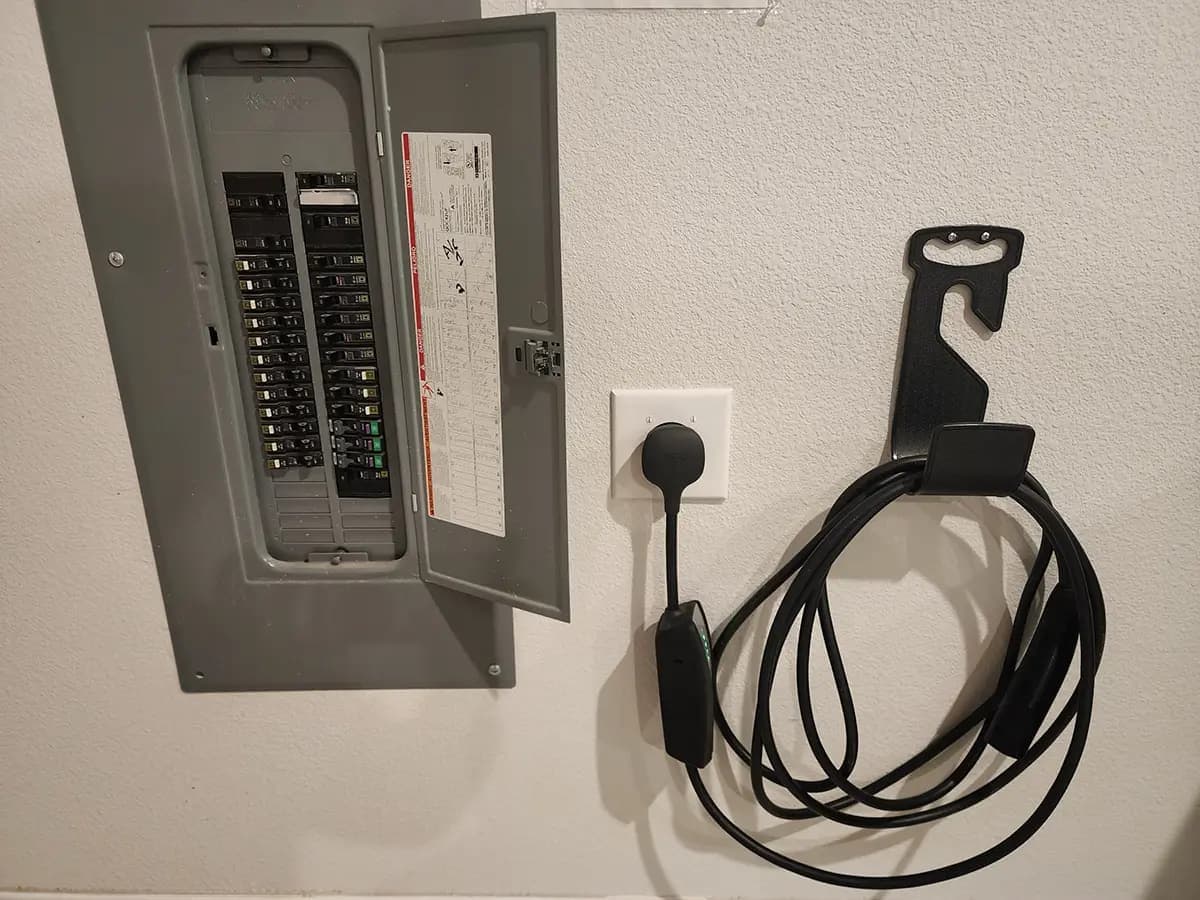
You do not need a meter for this. Open your panel door and look at the largest breaker, usually at the top, sitting alone above the two columns of smaller breakers. That is the main breaker, and the number stamped on its handle is your service size. In residential work you will almost always see 100, 125, 150, or 200.
Two things to watch for:
- Some panels have no main breaker. On a split or "main lug" setup the disconnect lives outside, in a separate box next to the meter. Read the number there instead.
- The label on the panel door is not the answer. That label states what the enclosure is rated to handle, which may be higher than what is actually feeding it.
If your panel still uses screw-in fuses instead of breakers, you are almost certainly on 60 or 100 amps, and the panel itself is old enough that its condition matters as much as its size. The same is true of panels from brands with known failure histories — Federal Pacific, Zinsco, and some Sylvania — which we cover on our breaker and panel repair page.
Panel rating vs. service rating: the number that matters
This is the single most common misunderstanding we run into on quotes, and it is worth being precise about.
Your service is the whole delivery chain: the utility conductors, the meter base, the service entrance cable, and the main breaker. Your panel is the enclosure and bus the breakers plug into. They have separate ratings, and the smallest rating in the chain is your real capacity.
So a homeowner can be entirely correct that they have "a 200-amp panel" and still be limited to 100 amps, because the main breaker is 100 amps and the wire from the meter was sized to match. It happens often — usually because a previous owner replaced a failing panel with a modern 200-amp enclosure without touching the service feed.
Why it matters for you: upgrading a service whose panel and meter base are already 200-amp-capable is a much smaller job than upgrading one where they are not. It is also why nobody can quote your upgrade over the phone — the price depends on which pieces of that chain already carry the new rating.
What 100-amp service handles, and when it's still fine
A 100-amp service is not a failure. It was the standard for decades, and plenty of homes run on it without a single problem — typically smaller homes where the big energy users burn gas instead of electricity:
- Gas furnace, gas water heater, gas range, gas dryer
- One central air conditioner
- No EV charger, no hot tub, no electric vehicle plans, no detached shop
Stack that load up and 100 amps has room. The trouble starts when the gas appliances come out, or when something large gets added. An electric range, an electric water heater, a heat pump, a hot tub, a welder, or a Level 2 EV charger each represent a serious block of simultaneous demand, and 100 amps runs out of room quickly once two or three of them share the house.
If your service is 100 amps and nothing on that list is in your plans, the right advice is often to leave it alone and address whatever is actually bothering you. Repeated breaker trips on one circuit, for instance, usually point to a problem on that circuit — not to a service that is too small. We would rather tell you that than sell you a panel.
What 200-amp service gives you
Most homes built across Celina, Prosper, and the rest of Collin and Denton County in the last twenty-five years came with 200-amp service for a straightforward reason: it comfortably carries everything a current household runs at the same time, with headroom left for whatever gets added next.
| 100-amp service | 200-amp service | |
|---|---|---|
| Code status | Minimum permitted for a one-family dwelling | Standard for new residential construction |
| Central AC + electric range + dryer together | Often at or near capacity | Comfortable headroom |
| Level 2 EV charger | Frequently needs a calculation, sometimes an upgrade | Usually supported |
| Hot tub, shop, or addition later | Limited | Room to grow |
| Spare breaker spaces | Commonly full or double-tapped | Typically available |
The headroom is the real product. A service upgrade is disruptive, permitted work, and not something you want to do twice — sizing once for the house you will have in ten years beats sizing twice for the house you have today.
How an electrician actually decides: the load calculation
Nobody competent recommends a service size from square footage. The NEC defines how this is calculated, and there are two routes a licensed electrician can take:
- The optional dwelling calculation (NEC 220.82). Available for a dwelling served by a single 120/240V service rated 100 amps or more. You total the connected load, then apply 100% to the first 10 kVA and 40% to everything above it, and add in the larger of the heating or cooling load. It reflects the reality that a house never runs every appliance at once. (Reference: EC&M, dwelling load calculations per the NEC)
- The existing-load method (NEC 220.87). For a house that is already lived in, the electrician can use your actual recorded maximum demand over the previous 12 months, take 125% of that figure, add the new load, and compare the result against the service rating. (Reference: Electrical Contractor Magazine on 220.87)
That second method is the one worth knowing about as a homeowner, because it is based on how your household actually uses power rather than on a worst-case paper total. It is frequently the difference between "you need a service upgrade" and "your existing service can carry this." If you are being told you need an upgrade and no calculation was done, that is a fair thing to ask about.
When 200 amps isn't enough either
Occasionally the answer is bigger than 200. We size above it when a property genuinely needs it:
- A large home with two or more HVAC systems plus all-electric appliances
- A detached shop or barn with motor loads, on a property that also has a well pump and a gate
- Two EV chargers plus a hot tub plus a pool
- A whole-home standby generator with a transfer switch sized for most of the house
In these cases the answer is usually a 320/400-amp service, or a 200-amp service plus a properly fed sub-panel at the outbuilding. Which one is correct depends on distances and loads, and it is a design decision rather than a catalog choice.
Adding load without upgrading the service
Here is the part most sizing articles leave out. If the only reason you are considering an upgrade is an EV charger, the service upgrade is not always required.
The NEC treats EV charging as a continuous load, so the circuit is sized at 125% of the charger's rating — a 40-amp charger needs a 50-amp circuit. But NEC 625.42 also allows the load on the service to be calculated from the maximum that an automatic load management system will permit, rather than from the charger's full nameplate rating. (Reference: WireRef, NEC Article 625) In plain terms: equipment that automatically throttles or pauses charging when the rest of the house is drawing heavily can let a charger fit onto a service that could not otherwise carry it at full output.
That is not a workaround — it is a code-recognized design, it is considerably cheaper than a service upgrade, and for a household that charges overnight it is usually invisible in daily use. We walk through the decision in do I need a panel upgrade for an EV charger.
What a 100-to-200-amp upgrade involves
When an upgrade is the right call, this is the shape of the job. Going from 100 to 200 amps is not a breaker swap — the whole chain has to be rated for the new service:
- New 200-amp panel and breakers, correctly labeled
- New service entrance conductors and, usually, a new meter base
- Grounding and bonding brought up to current code, which is often the quietly overdue part on an older home
- Coordination with the utility for a brief disconnect and reconnect
- A permit pulled by the licensed electrician and a municipal inspection before power is released
Texas requires the permit and the inspection — see do you need a permit to upgrade an electrical panel in Texas for how that works and roughly what the city charges. For current pricing, our panel upgrade cost guide covers typical Collin County ranges and what moves them, and the electrical panel upgrades page explains our process end to end.
Getting the right answer for your home
Panel sizing is one of those questions where the honest answer really does require looking. What sits behind your meter, how much of the chain is already rated for 200 amps, and what your household actually draws all have to be read off your house rather than guessed from a guide.
If you are in Celina, Prosper, McKinney, Frisco, Plano, or anywhere else across the Dallas-Fort Worth area, request a free quote and we will do the load calculation, tell you plainly what your service can and cannot carry, and give you an itemized number before any work starts. If the calculation says your existing service is fine, that is what we will tell you.
Sources
- Texas Department of Licensing and Regulation — Electricians Compliance Guide (2023 NEC adopted statewide, effective September 1, 2023)
- EC&M — Services and the NEC, Part 2 (NEC 230.79(C): one-family dwelling disconnect rated at least 100A)
- EC&M — Dwelling Load Calculations Per the National Electrical Code (NEC 220.82 optional method)
- Electrical Contractor Magazine — Using optional calculations for determining existing loads (NEC 220.87)
- WireRef — NEC Article 625: EV Charging Equipment (continuous load, 125% sizing, load management)
Frequently asked questions
Is 100-amp service enough for a house?
It can be. A 100-amp service is still the code minimum for a one-family dwelling, and it is usually workable for a smaller home with gas heat, a gas water heater, and a gas range. It gets tight fast once you add electric heat, an electric range, a hot tub, a shop, or an EV charger. The honest answer comes from a load calculation on your specific home, not from the square footage.
What is the difference between 100-amp and 200-amp service?
It is the amount of power the utility feed, meter, and main breaker can safely deliver to the house at one time. A 200-amp service can carry roughly twice the simultaneous load of a 100-amp service, which is why it is the practical standard for a modern home running central air, electric appliances, and EV charging together.
How do I know what amp service I have?
Read the number stamped on the main breaker at the top of your panel - 100, 125, 150, or 200 are the common residential ratings. If there is no main breaker in the panel, check the outdoor disconnect next to the meter. The label on the panel door tells you what the enclosure is rated for, which is not always the same as what the service actually delivers.
Can I have a 200-amp panel on a 100-amp service?
Yes, and it is a common source of confusion. A panel enclosure rated for 200 amps can be fed by a 100-amp main breaker and 100-amp utility conductors. The service is still 100 amps. The smallest piece in the chain - the feed, the meter base, or the main breaker - sets your real capacity.
Do I need to upgrade to 200 amps to install an EV charger?
Not always. Roughly one in five homes needs a service upgrade first. Many homes have enough spare capacity for a Level 2 circuit, and where they do not, an energy management system that limits charging current can sometimes let the charger be added without touching the service. Either way it starts with a load calculation.
Does a panel upgrade in Texas require a permit?
Yes. A licensed electrician pulls the permit and the work has to pass a municipal inspection before the utility releases power to the new service. We handle the permit and the inspection as part of every upgrade.