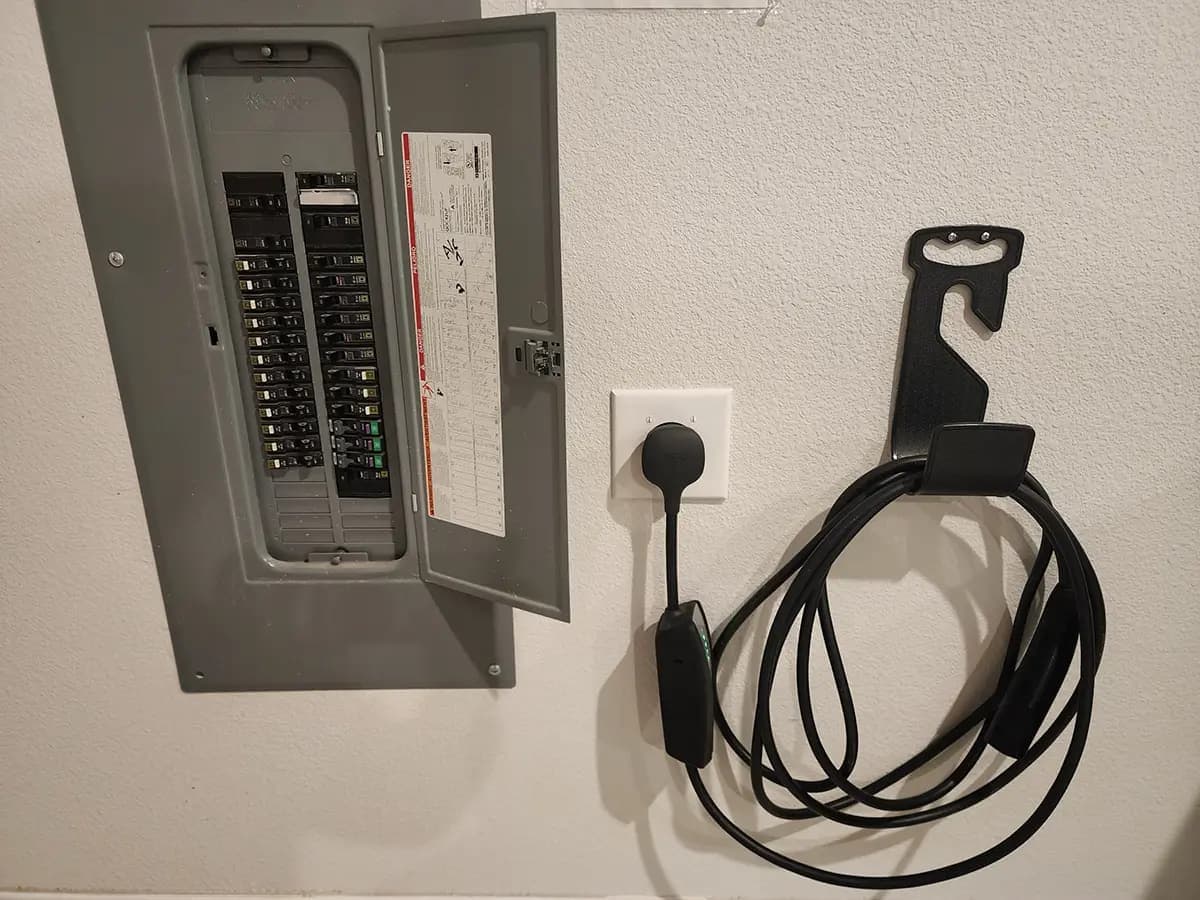
Every few months someone calls and opens with "I think I need 400-amp service." Occasionally they are right. More often the number came from a builder, a solar salesperson or a forum thread, and the honest answer after a load calculation is that 200 amps carries the house with room left over.
A 400-amp service is a real and sometimes necessary job. It is also several times the price of a 200-amp upgrade, it brings new equipment and new utility coordination with it, and it is one of the easiest things in residential electrical work to be oversold. Here is what the term actually means on the equipment, which loads genuinely justify it, how the design works, and the two cheaper answers worth pricing first.
The short answer
Most homes asking about 400-amp service do not need it, and the load calculation is what settles the question. 200-amp service is the practical standard for a modern North Texas home and handles central air, electric appliances, a hot tub and a Level 2 EV charger in most houses. You cross into 400-amp territory when the calculated load on your specific home genuinely exceeds 200 amps - large square footage with multiple HVAC systems, all-electric appliances, a detached shop with motor loads, or several large new loads landing at the same time.
There is one more thing worth knowing before you shop the job, because quotes describe it two different ways: in residential work, "400-amp service" and "320-amp class" generally point at the same tier.
"400 amps" and "320 amps" describe the same tier
If you collect three quotes you may well see all three use a different number for the same job. InspectandTest's 2026 panel upgrade guide lists it as one line item - "Service upgrade to 400 amps (or 320-amp class)" - which is a fair reflection of how the trade talks about it.
Two things follow, and both are worth raising on a quote:
- The equipment requirements come from your utility, not from the code. Which meter socket and service equipment is acceptable at this size is set by the utility or electric cooperative serving your address, and those requirements genuinely differ from one provider to the next. We confirm them for your specific address before anything is ordered, because getting that wrong is a returned-equipment delay rather than a design problem.
- The number on the label is not the capacity your house gets. That has a specific code basis we come back to below: the service conductors and the calculated load govern what the house can actually draw, regardless of what the disconnects add up to.
So the useful question on a 400-amp quote is not "is it 320 or 400." It is: what did the load calculation come out at, and what has my utility confirmed for this address?
The loads that actually justify 400 amps
Here is the honest list, from the jobs where the calculation has actually come out above 200 amps:
- A large home with two or more HVAC systems plus all-electric appliances. This is the most common genuine case across Prosper, Celina and the newer Frisco builds - a 4,500-square-foot-plus house with multiple condensers, electric heat, an electric range and an electric water heater.
- A detached shop or barn with real motor loads, on a property that also has a well pump, a gate operator and irrigation. Acreage properties around Weston, Gunter, Lucas and Pilot Point generate most of these.
- Several large loads arriving at once. Two EV chargers plus a pool plus a hot tub plus a shop, all added in the same year, is a different problem from adding any one of them.
- A whole-home standby generator with a transfer switch sized for most of the house, where the service equipment is being reworked anyway.
- A guest house, casita or ADU on the same service that pushes the combined calculated load past what a 200-amp service can carry.
What is not on the list: square footage by itself, a full breaker panel, a single EV charger, or a solar and battery installation. A full panel with a healthy service is a slot problem, not a capacity problem - our sub-panel installation page explains the difference and why the cheaper fix is often the correct one. One EV charger is almost never a 400-amp conversation, and we walk through why in do I need a panel upgrade for an EV charger.
The load calculation is what decides, not the square footage
There are two code-recognized ways to get the number, and which one your electrician uses matters.
The standard and optional calculations in NEC Article 220 build the load from the house on paper: general lighting and receptacle load, fixed appliances, HVAC, range, dryer, and the new load you are adding, with the code's demand factors applied. EC&M's walkthrough of dwelling load calculations covers the optional method in NEC 220.82, which is the one most often used on residential work.
The existing-load method in NEC 220.87 is the one that keeps homeowners out of unnecessary upgrades. It allows the calculation to be based on the maximum demand your service has actually recorded rather than a worst-case paper total. Electrical Contractor Magazine's piece on the optional existing-load calculation explains how that provision works and where it came from. On a house that has been lived in for years, it frequently returns a materially smaller number than the paper calculation does.
Two code rules then set the floor:
- NEC 230.79 requires the service disconnect to be rated at least the calculated load from Article 220, and never below the minimums in that section.
- NEC 230.42 requires the service conductors to have an ampacity of at least the largest of the Article 220 calculations.
So the sequence is calculation, then service size, then equipment - in that order. If you are being told you need 400 amps and nobody has run a calculation on your home, that is the one thing worth pushing back on.
The dwelling rule that makes 400 amps the ceiling
There is a code allowance specific to one-family homes that is worth knowing, because it quietly defines the top of the residential range.
Service conductors supplying the entire load of a one-family dwelling are permitted to be sized smaller than the service rating would otherwise require - at 83 percent of it. Writing in EC&M, Mike Holt states the rule as applying to ungrounded service conductors "not over 400A" supplying the entire load of a one-family dwelling, with the ampacity sized to 83 percent of the service overcurrent device rating. (That Q&A was written against the 2017 NEC, when the allowance was numbered 310.15(B)(7); in current editions it lives in NEC 310.12.)
Three consequences:
- 400 amps is where the concession stops. The allowance covers conductors not over 400 amps. Design above that and the dwelling discount no longer applies, which is one reason residential services very rarely go past this tier.
- It only applies to conductors carrying the whole house. A feeder out to a garage sub-panel does not qualify, even on a 400-amp service.
- It does not apply to two-family or multifamily service conductors, which catches people out on duplexes and guest-house arrangements.
This is also why the conductor size on a 400-amp quote can look smaller than a homeowner expects. It is not a corner being cut - it is a specific dwelling allowance, and it is the reason the price difference between 200 and 400 amps is driven by the service equipment and the utility work more than by the wire.
Two 200-amp panels, or one 400-amp main?
Almost every residential 400-amp service is built one of two ways, and the difference shows up on the quote.
Two 200-amp disconnects. The NEC permits more than one service disconnect. In EC&M's summary of the service requirements, Mike Holt puts it directly: each service must have only one service disconnect except as permitted in NEC 230.71(B), and each service can have up to six service disconnects - for example, panelboards with a service disconnect in each panelboard. Those disconnects must be grouped and marked to indicate the load served, per NEC 230.72(A). Two 200-amp main-breaker panels in grouped service equipment is therefore a normal, code-compliant 400-amp design, and it is usually the less expensive of the two.
One 400-amp main. A single large service disconnect feeding distribution downstream. Fixr's panel upgrade cost guide describes the same two options and notes that the single-panel version is generally the more expensive one.
Now the part that gets glossed over. Two 200-amp panels do not automatically give you 400 amps of usable capacity. The same EC&M summary sets out NEC 230.90(A) Exception No. 3: the combined ratings of two to six service disconnects may exceed the ampacity of the service conductors only if the calculated load does not exceed the ampacity of those conductors per Article 220. The service conductors and the calculated load still govern what the house can draw. Adding a second 200-amp panel to an existing 200-amp service is not a 400-amp upgrade; it is a sub-panel with extra steps unless the service itself is replaced.
Which arrangement is right for your home depends on where the loads sit, where the meter is, how far the detached building is, and what your utility and city will accept. It is a design decision, not a catalog choice.
The 2026 code change that affects every Texas service upgrade
If you are planning a service upgrade in Texas right now, this one matters regardless of the amperage.
Texas adopts the National Electrical Code as the state electrical code through the Texas Department of Licensing and Regulation, and the 2026 NEC took effect statewide on September 1, 2026, with a limited exception covering GFCI requirements on certain outdoor outlets.
The 2026 edition reorganized the dwelling emergency disconnect requirement that arrived in 2020. Writing in EC&M, Ryan Jackson describes it plainly: Section 230.85 was deleted, many of its former requirements were relocated into 230.70, and with one key difference - the service disconnect must be outdoors for one- and two-family dwellings. In his summary of the same changes for the Independent Electrical Contractors, he adds that the previous workarounds are gone: "No more stickers and no more meter disconnects." EC&M's figure caption cites NEC 230.70(A)(1) for the location requirement and 230.70(B)(2) for the markings.
What that means for a service upgrade, 200 or 400 amps:
- The service disconnect goes outside, at or near the meter, rather than relying on a label on an indoor panel.
- A design that passed inspection under an older edition is not automatically the design your inspector will accept now.
- Cities may be inspecting to a different edition than the state minimum, and several in our area are. We confirm which edition applies at your address when we pull the permit rather than assuming.
There is a second item that surprises people on the quote: since the 2020 code cycle a surge protective device has been required when service equipment is replaced on a dwelling. It is part of the job, not an add-on - is whole-home surge protection worth it covers the requirement and what the device does and does not protect.
Two cheaper answers that often win
Before you price a 400-amp service, price these. On a real share of the homes that call about 400 amps, one of them is the right answer.
A 200-amp service plus a properly fed sub-panel. If the capacity problem is really a location problem - a shop two hundred feet out, a garage conversion at the far end of the house, a pool equipment pad - the fix is a correctly sized feeder and a panel where the load is, not a bigger service at the house. This is the single most common substitution we make on a 400-amp inquiry. Sub-panel installation walks through when it works and when it just relocates the bottleneck.
Load management on the EV charging. NEC 625.42 permits the load on the service to be calculated from the maximum an automatic load management system will allow, rather than from the charger's full nameplate rating. (Reference: WireRef, NEC Article 625) Equipment that throttles or pauses charging when the rest of the house is drawing heavily can fit one or even two chargers onto a service that could not otherwise carry them at full output. It is a code-recognized design, not a workaround, and for a household that charges overnight it is usually invisible. Our EV charger installation page covers how we size it, and 200-amp vs 100-amp panel covers the sizing decision one tier down.
The case where neither substitution works is the one where the house itself has outgrown 200 amps - multiple HVAC systems, all-electric appliances, and simultaneous demand that the existing-load calculation confirms rather than contradicts. That is a genuine 400-amp job and we will tell you so.
What a 400-amp service upgrade costs
No electrician can quote this over the phone, and the published national figures disagree widely enough that they are best used as a sanity check rather than a budget:
| Source | 400-amp service upgrade | 200-amp upgrade, same source |
|---|---|---|
| Fixr, updated January 2025 | $8,000 - $12,000 | $1,800 - $4,500 |
| InspectandTest, updated November 2026 | About $5,000 - $10,000+ | About $2,500 - $6,000 (100 to 200 amps) |
Both are national averages, not quotes, and the two scopes are not identical - note that the InspectandTest 200-amp figure is specifically a 100-to-200-amp service upgrade. What they agree on is the shape of the thing: a 400-amp service is a multiple of a 200-amp upgrade, and InspectandTest attributes the gap to "larger equipment, often two panels, more utility work."
What actually moves your number:
- How much of the existing chain already carries the new rating. The service conductors, the meter base and the disconnect all have to be rated for the new service. A home where none of them are is a bigger job than one where some already are.
- Meter location and the length of the new service run, including whether any of it is underground and whether a driveway, slab or irrigation is in the way.
- What your utility requires at this size. Metering and service equipment requirements are the utility's, they differ by provider, and they can change both the equipment list and the lead time.
- One disconnect or two, whether new outdoor service equipment is required under the current code edition, your city's permit fee, and the required surge protective device.
- Any corrective work the inspection exposes - grounding and bonding on an older home is the item that most often turns out to be quietly overdue.
For the 200-amp baseline in our own market, our panel upgrade cost guide covers typical Collin County ranges, and the North Texas electrician cost guide explains how we price labor and service calls.
Permits, the utility, and the order things happen in
A service upgrade touches three parties, and the sequence is not optional.
- Load calculation and design. The calculated load sets the service size; the service size, the utility's requirements and the adopted code edition set the equipment.
- Permit. Pulled by the licensed electrical contractor, with contractor registration where the city requires it. Our Texas panel permit guide explains what the city is checking and roughly what it charges.
- Utility coordination. New service equipment means a scheduled disconnect and reconnect, and the utility's own requirements - equipment location, clearances, metering - can drive the design. We confirm them before ordering rather than after.
- Installation. New service conductors, meter base, outdoor service disconnect, panel or panels, grounding and bonding brought to current code, surge protective device, and correct labeling.
- Inspection, then energizing. The municipal inspection comes before the utility releases power to the new service. That order is the whole reason the permit is worth having: the sign-off is your documentation at resale and at claim time.
Expect power off for part of a day on the installation itself, and expect the overall timeline to be set by the permit and the utility rather than by the labor.
How we scope a 400-amp service
We start with the calculation, not the catalog. That means reading your existing service end to end - conductors, meter base, disconnect, panel, grounding and bonding - running the Article 220 calculation on your actual home, and running the existing-load method where your service history supports it. Then we tell you which of three situations you are in: your 200-amp service is fine and the problem is slots or location, your service needs replacing at 200 amps, or your calculated load genuinely puts you in the 320/400 tier.
Tamenator Electrical Services is a licensed and insured Texas electrical contractor regulated by TDLR, owner-operated by Tamen Privratsky with 13-plus years of residential experience, serving Celina, Prosper, McKinney, Frisco, Plano and the rest of the Dallas-Fort Worth area. We confirm the utility's requirements and the adopted code edition at your address before quoting equipment, and we pull the permit and schedule the inspection as part of the job.
One thing we will not do is sell you the bigger service because it is the bigger ticket. If the calculation says 200 amps carries your house, that is what we will tell you, with the reasoning shown. If you are weighing a shop, a second charger, a pool or an addition and want to know what your service can actually carry, request a free quote and we will start with the math. For the full upgrade process end to end, see electrical panel upgrades.
Sources
- EC&M, "NEC Requirements for Services - Part 2," Mike Holt, May 15, 2024 (NEC 230.71(B): one service disconnect except as permitted, up to six service disconnects; NEC 230.72(A): disconnects grouped and marked to indicate the load served; NEC 230.79: disconnect rated at least the Article 220 calculated load; NEC 230.42: service conductor ampacity; NEC 230.90(A) Exception No. 3: combined ratings of two to six disconnects may exceed conductor ampacity only where the calculated load does not)
- EC&M, "Stumped by the Code? Rule for Sizing Service Conductors for Dwellings," Mike Holt (the 83 percent dwelling allowance for ungrounded service conductors not over 400A supplying the entire load of a one-family dwelling; the entire-load condition; not applicable to two-family or multifamily service conductors. Written against the 2017 NEC, where the rule was numbered 310.15(B)(7); now NEC 310.12)
- EC&M, "Key Revisions to Chapter 2 of the 2026 NEC," Ryan Jackson, September 15, 2026 (NEC 230.85 deleted and its requirements relocated into 230.70, with the service disconnect required outdoors for one- and two-family dwellings; 230.70(A)(1) location and 230.70(B)(2) markings)
- Independent Electrical Contractors, "National Electrical Code 2026 Changes to Chapter Two," Ryan Jackson, April 9, 2026 (230.85 deleted and relocated to 230.70; service equipment for one- and two-family dwellings now must be outdoors; "No more stickers and no more meter disconnects")
- Texas Department of Licensing and Regulation - Commission adopts rules (2026 NEC adopted as the Texas state electrical code effective September 1, 2026, with a limited GFCI exception)
- EC&M, "Dwelling Load Calculations Per the National Electrical Code" (NEC 220.82 optional method for dwelling load calculations)
- Electrical Contractor Magazine, "When a Local Requirement Went National: Using Optional Calculations for Determining Existing Loads" (NEC 220.87 existing-load calculation based on recorded maximum demand)
- WireRef, "NEC Article 625: EV Charging Equipment" (NEC 625.42: service load may be calculated from the maximum an automatic load management system permits)
- Fixr, "Electrical Panel Upgrade Cost," updated January 31, 2025 (upgrade to 400 amps $8,000-$12,000; upgrade to 200 amps $1,800-$4,500; the 400-amp option as either a single 400-amp panel or a pair of 200-amp panels, with the single panel generally the most expensive)
- InspectandTest, "Electrical Panel Upgrade Cost: Typical Ranges in 2026," published October 18, 2026, updated November 12, 2026 ("Service upgrade to 400 amps (or 320-amp class)" about $5,000-$10,000+, attributed to larger equipment, often two panels, and more utility work; 100-to-200-amp service upgrade about $2,500-$6,000)
Frequently asked questions
Is 400-amp service overkill for a house?
For most homes, yes. 200-amp service comfortably carries central air, electric appliances, a hot tub and a Level 2 EV charger in a typical North Texas house. A 400-amp service earns its cost when a load calculation on your specific home comes out above 200 amps - usually a large house with two or more HVAC systems and all-electric appliances, a detached shop with motor loads, or several big new loads arriving at once. The calculation decides, not the square footage.
What is the difference between 320-amp and 400-amp service?
In residential work the two labels generally point at the same tier of service - cost guides list it as a single line item, "service upgrade to 400 amps (or 320-amp class)." The numbers describe equipment ratings, and which meter socket and service equipment is acceptable at that size is set by the utility or cooperative serving your address rather than by the National Electrical Code. Those requirements genuinely differ between utilities, so the specific equipment has to be confirmed for your address before anything is ordered. Either way, the amperage on the label is not the same thing as the capacity your load calculation supports.
Can you get 400-amp service with two 200-amp panels?
Yes, and it is the common arrangement. The NEC permits up to six service disconnects for a single service, so two 200-amp main breakers in grouped service equipment is a normal 400-amp design. NEC 230.90(A) Exception No. 3 allows the combined ratings of those disconnects to exceed the ampacity of the service conductors only where the calculated load does not exceed that ampacity. In other words, two 200-amp panels do not automatically mean 400 amps of usable capacity - the load calculation and the service conductors still govern.
Do I need 400-amp service for two EV chargers?
Usually not. Two Level 2 chargers add significant load, but NEC 625.42 lets the service load be calculated from the maximum that an automatic load management system will permit rather than from both chargers at full output. Shared load management across two chargers is frequently cheaper than a service upgrade and is invisible to a household that charges overnight. We run the load calculation both ways and show you the difference before you commit.
Does a 400-amp service upgrade need a permit in Texas?
Yes. A service upgrade is permitted, inspected work in every city we serve, and the utility will not energize new service equipment until the municipal inspection has passed. The permit is pulled by the licensed electrical contractor, not the homeowner. We handle the permit, the utility coordination and the inspection scheduling as part of the job.
How much does a 400-amp service upgrade cost?
Published national estimates vary widely. Fixr's panel upgrade guide, updated January 2025, gives $8,000 to $12,000 for an upgrade to 400 amps against $1,800 to $4,500 for an upgrade to 200 amps. InspectandTest's 2026 guide puts a 400-amp or 320-amp-class service upgrade at about $5,000 to $10,000 or more. Those are national averages rather than quotes - the real number depends on the meter location, the length and routing of the new service, how much of the existing chain carries the new rating, and your city's permit fee. We quote after a load calculation and a look at the service entrance.