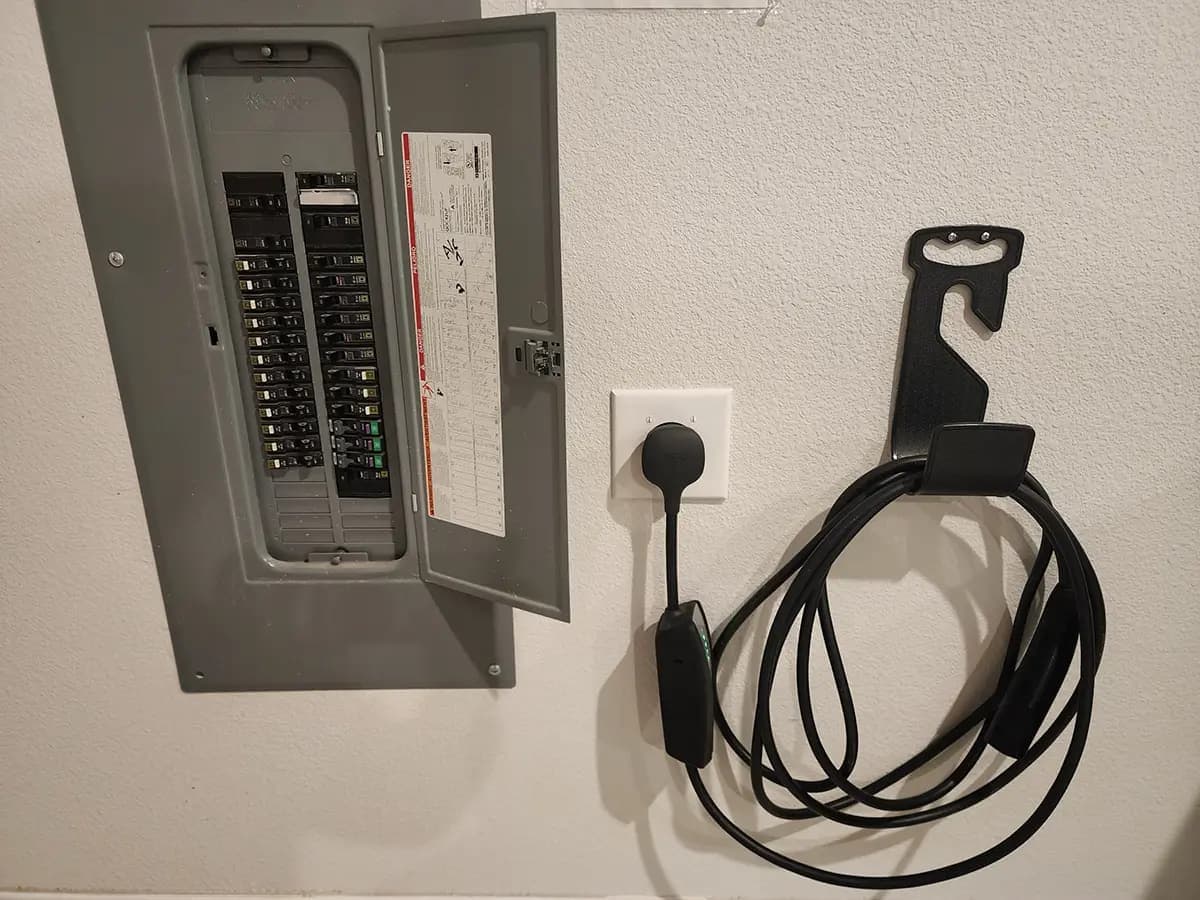
A tripping breaker is the one electrical fault homeowners are tempted to treat as a nuisance, because resetting it appears to work. You walk out to the panel, flip the handle back, the microwave comes on again, and the problem looks solved right up until it is not.
It is worth knowing what happened in that half second. A breaker is a measuring device with a switch attached, and when it opens it has measured something specific: too much current for too long, a sudden collapse of resistance somewhere, current leaving the circuit and never coming back, or electricity jumping a gap it should not be jumping. Those are four different problems with four different fixes, and only one of them is harmless.
The short answer
A breaker that trips occasionally under a heavy load is almost always an overloaded circuit, and the fix is to move something onto a different circuit. A breaker that trips repeatedly, trips with nothing plugged in, will not stay reset, or trips alongside heat, buzzing or a burning smell is a fault in the wiring or in the breaker itself, and resetting it is not a fix. Everything below is about working out which of those two you have.
Four things a trip can mean
Overload. More current is flowing than the circuit is rated to carry, usually because too many things are running at once. The circuit is intact; the demand is too high. This is the only cause on the list you can often solve yourself.
Short circuit. A hot conductor is touching a neutral or another hot, and current takes that path instead of the intended one. Current rises almost instantly and the breaker opens in a fraction of a second. A damaged cord, a crushed cable or a failed appliance will all do it.
Ground fault. Current is leaking out of the circuit to ground - through a damaged cable, a wet fixture, or a person. A standard breaker only sees this if the leakage is large enough to look like an overload or a short, which is exactly why GFCI protection exists.
Arc fault. Electricity is jumping a gap at a loose terminal, a nicked conductor or a broken wire inside a wall. The current involved can be low enough that a standard breaker never reacts. As EC&M puts it, standard circuit breakers only trip when they detect an overload or short circuit, and do not protect against the arc faults that can lead to fires.
That last point is the one most people have never been told: an ordinary breaker is not watching for two of the four problems on this list, which is the whole reason GFCI and AFCI devices exist.
Why the breaker waits before it trips
A common question is why a breaker holds for twenty minutes and then lets go. Nothing is wrong with it. A standard thermal-magnetic breaker has two separate trip mechanisms, and you are watching the slow one.
The thermal element is a bimetal strip heated by the load current. It bends as it warms, and when it bends far enough it releases the latch. Because heating takes time, the trip time varies inversely with how far over the rating you are. Published trip-curve figures for molded case breakers put the thermal element at roughly 1,800 seconds at 135 percent of rating, about 60 seconds at 250 percent, and around 10 seconds at 500 percent. The magnetic element is the fast one: an electromagnet in series with the load that, on a short circuit at about 400 percent of rating, opens the breaker in less than one cycle.
The timing is therefore a clue in itself. A trip that takes several minutes under load is a mild, sustained overload. A trip that is instant and repeatable is a fault.
The fifteen-minute test you can run yourself
This narrows the problem down considerably, and none of it requires opening the panel:
- Write down what was running. Which room, which appliances, what time of day. Patterns matter more than any single trip.
- Unplug everything on that circuit. Pull every cord, including chargers and anything in a nearby room that may share the circuit.
- Reset the breaker once. Push the handle fully to OFF first, then back to ON. A tripped breaker does not reset from the middle position.
- If it holds with nothing plugged in, add loads back one at a time, several minutes each. If it trips when one specific appliance comes on, the appliance is your answer, not the house.
- If it trips immediately with nothing plugged in, stop. That is a fault in the fixed wiring or in the breaker, and the next step is a diagnosis, not another reset.
- If it is a GFCI or AFCI breaker - look for a TEST button on the breaker itself - skip to the two sections below, because those trip for different reasons entirely.
Resetting once to see whether it holds is reasonable. Resetting the same breaker over and over is not.
Overload: the arithmetic behind most trips
Overload is the most common cause and the easiest to confirm, because it is arithmetic.
A 120-volt, 15-amp circuit carries 1,800 watts at its nominal rating. The code sizes branch-circuit conductors serving continuous loads at 125 percent of the load - the flip side of the familiar guidance that a circuit is comfortable at about 80 percent of its number, roughly 12 amps or 1,440 watts on a 15-amp circuit for anything running a long stretch.
Now look at what one appliance takes. A 1,500-watt space heater draws 12.5 amps at 120 volts by itself - the whole continuous budget of a 15-amp circuit before you switch on a lamp. A window air conditioner, a microwave, a hair dryer, a shop vacuum and a portable compressor land in similar territory. Two of them on one circuit is not bad luck; it is a sum.
The practical fixes, in order of cost:
- Move the heavy appliance to a circuit that is not already loaded.
- Stop running two high-draw appliances in the same room at once.
- Have a dedicated circuit installed for the appliance that keeps causing it. This is the correct answer for a garage freezer, a shop tool, a window unit or a hot tub, and it is far cheaper than any panel work.
- If the entire house is running out of headroom rather than one circuit, that is a capacity question - our guide on 200-amp vs 100-amp panels walks through how to read your current service size and when the service itself is the limit.
When the breaker or the panel is the problem
Breakers are mechanical, and they wear. One that has tripped a few hundred times, or sat on a bus connection cycling through twenty North Texas summers, can start opening below its rating or failing to hold at all. Loose terminal screws and double-tapped breakers - two conductors jammed under one screw - produce heat at the connection and intermittent trips that follow no reproducible pattern.
Then there is the equipment question. Panels sold under the Federal Pacific Electric (Stab-Lok), Zinsco and some Challenger names have a documented history of breakers that do not trip reliably under fault conditions. A breaker in one of those that trips constantly is worrying; one that never trips is worse. We do not repair those piecemeal, and we say so directly rather than quoting a patch. Our guide to electrical panel brands to avoid sets out what the public record actually says about each of them and how to identify your own panel from the label.
Telling these apart means opening the panel and testing, which is what our breaker and panel repair service is for. If the fault turns out to be the panel rather than a component, that becomes an electrical panel upgrade conversation - but a single failed breaker in a sound modern panel is a small repair, and the small repair is most of what we see.
A GFCI trip is telling you something else
A GFCI is not counting amps. It compares the current going out on the hot against the current returning on the neutral, and it opens when the difference reaches roughly 5 milliamperes - a threshold OSHA describes as acting within as little as 1/40 of a second. That is set for human shock protection, not for overload, which is why a GFCI can trip on a circuit that is barely loaded. OSHA also notes the limit of the device: it will not protect you from line contact hazards, such as touching two energized conductors at once.
What actually trips them in practice:
- Moisture. Water in an outdoor receptacle cover, a landscape fixture, a pool or spa equipment enclosure, or an extension cord lying in wet grass. This is the North Texas classic after a storm.
- A failing appliance. Older motors and heating elements leak a little current to ground as they age. A GFCI will find that long before anything else does.
- Long circuit runs with many devices, where small amounts of normal leakage add up.
- The device reaching end of life. Since June 29, 2015, UL 943 has required GFCI receptacles and breakers to include an auto-monitoring circuit that tests the device periodically on its own, and to deny power when that self-test fails at end of life. A GFCI that has simply stopped passing power may have retired itself.
Where GFCI protection is required is also moving. The Texas Department of Licensing and Regulation adopted the 2026 National Electrical Code as the state electrical code effective September 1, 2026, with a limited exception covering ground-fault circuit interrupter requirements on certain outdoor outlets, and individual cities may still be inspecting to an earlier edition. We confirm which one applies at your address rather than assuming.
An AFCI trip is telling you a third thing
AFCIs watch for the electrical signature of arcing. Their circuitry is built to distinguish harmless arcing - vacuum motors, dimmed loads, solid-state electronics - from the arcing produced by a loose connection or a broken conductor. The protection now covers most living areas of a dwelling: the 2008 code cycle brought in family rooms, dining rooms, living rooms, bedrooms, sunrooms, closets, hallways and more, and the 2014 cycle added kitchens and laundry areas.
When one trips and nothing obvious is wrong, UL's published guidance is a specific order of checks: first confirm it is not a real arcing fault, such as a conductor pinched under a staple, since that is not a nuisance trip at all; then isolate loads one at a time; then look at the neutral. Most AFCIs will not function properly on multiwire branch circuits that share a neutral between two circuits, and a neutral inadvertently connected to ground will also trip the device. UL is equally clear on testing: the only way to test an AFCI for proper operation is the test button on the AFCI itself.
That is diagnostic work rather than a parts swap, and it is where a perfectly good breaker most often gets replaced for nothing.
What makes this a North Texas problem specifically
Three things stack up locally. Summer load is the first: a house running air conditioning flat out for four months, with a pool pump, a garage refrigerator and an EV charging overnight, sits far closer to its service capacity than the same house in a mild climate. Storm exposure is the second - driven rain into outdoor receptacles, pool and spa equipment pads and landscape lighting is behind most of the GFCI trips we get called for. Housing stock is the third: much of the inventory in Plano, Richardson, Carrollton and North Dallas was wired between the 1970s and the 1990s, for a household that owned a fraction of what yours plugs in.
If the tripping comes with flickering, warm switch plates or two-prong receptacles, the circuit may not be the real story - signs your home needs rewiring covers what points toward the wiring itself.
When to stop and call
What the breaker is protecting is usually invisible, which is the real reason we never tell anyone to just keep resetting it. NFPA's research on home structure fires found that from 2019 through 2023, electrical distribution or lighting equipment caused an annual average of 31,650 home fires, 430 deaths, 1,300 injuries and $1.6 billion in direct property damage - the leading cause of home fire property damage. Its earlier equipment-specific analysis adds the detail that matters here: wiring and related equipment accounted for just over two-thirds of those fires, and faulty wiring in concealed spaces such as attics and wall cavities is particularly dangerous because it can burn for a prolonged period before anybody notices.
So stop resetting and get it looked at if any of these are true:
- The breaker will not stay on, or trips instantly with every load unplugged
- The panel, a breaker or a cover plate is warm, discolored or scorched
- You hear buzzing, humming or crackling from the panel
- There is any burning or hot-plastic smell near the panel or an outlet
- A breaker trips while nothing in the house has changed
- Lights dim or flicker whenever a large appliance starts
- The panel is a Federal Pacific, Zinsco or Challenger
A burning smell or a hot panel is not a scheduling conversation - that is what our emergency electrician service exists for, and the right move is to shut that circuit off and call.
How we diagnose a tripping breaker
We open the panel and test rather than guess: a visual inspection for heat damage, corrosion and loose or double-tapped connections; testing breakers and circuits to isolate whether the fault sits in the breaker, the wiring or a connected device; checking the panel brand and age against known hazard equipment; and reviewing grounding and bonding, which is skipped more often than anything else on older installations. We carry common breaker types on the truck, so a straightforward repair is frequently finished the same visit.
Tamenator Electrical Services is a licensed and insured Texas electrical contractor regulated by TDLR, owner-operated by Tamen Privratsky with 13-plus years of residential experience, serving Celina, Prosper, McKinney, Frisco, Plano and the rest of the Dallas-Fort Worth area. The honest answer is often smaller than homeowners expect, and we will say so rather than quoting the largest version of the job by default.
If you would rather know why than keep walking to the panel, request a free quote and describe the pattern - which circuit, what was running, and whether it holds with everything unplugged. If you want the whole system looked at rather than the one circuit, that is an electrical safety inspection, and our electrician cost guide for North Texas publishes what diagnostic and repair work generally runs here.
Sources
- NFPA, Home Structure Fires, Shelby Hall and Tucker McGree, August 2025 (2019-2023 averages for electrical distribution and lighting equipment fires)
- NFPA, Home Fires Caused by Electrical Distribution and Lighting Equipment, Richard Campbell, February 2022 (wiring share; concealed-space fires)
- OSHA Construction eTool - Ground-Fault Circuit Interrupters (approximately 5 milliamperes; within as little as 1/40 of a second; line contact hazards)
- EC&M - The Apprentice's Guide to AFCIs and the NEC, Harold De Loach, January 31, 2025 (what standard breakers do and do not detect; NEC 210.12 areas by code cycle)
- IAEI Magazine, UL Question Corner - nuisance trips on a UL Listed AFCI (confirm a real arcing fault first; shared and inadvertently grounded neutrals; test button only)
- IAEI Magazine, UL Question Corner - Self-testing GFCI Requirements (UL 943 auto-monitoring effective June 29, 2015; power denial at end of life)
- EC&M - The Basics of Molded Case Circuit Breakers (bimetal thermal trip and magnetic trip; trip-curve times at 135, 250, 400 and 500 percent of rating)
- EC&M - The NEC and Branch-Circuit Ratings, Part 1, Mark Lamendola, December 7, 2021 (125 percent sizing for continuous loads, Sec. 210.19(A)(1)(a))
- TDLR - Commission adopts rules adopting the 2026 National Electrical Code effective September 1, 2026, with a limited GFCI exception for certain outdoor outlets
Frequently asked questions
Why does my breaker keep tripping?
A breaker trips for one of four reasons: the circuit is drawing more current than it is rated for (an overload), a hot conductor is touching a neutral or another hot (a short circuit), current is leaking to ground (a ground fault), or the breaker is a GFCI or AFCI that has detected leakage or arcing. An overload trips under heavy load and stops when you move something to another circuit. The other three do not resolve on their own, and repeated resetting does not fix any of them.
Is it safe to keep resetting a tripped breaker?
Resetting once to see whether it holds is reasonable. Resetting the same breaker over and over is not, because the breaker is the only thing standing between a fault and the wiring in your walls. Stop resetting entirely if the breaker will not stay on, trips instantly with nothing plugged in, feels warm, buzzes, or if there is any burning smell or discoloration at the panel.
Why does my breaker trip twenty minutes after I turn something on?
That is the thermal element doing exactly what it is designed to do. A standard breaker uses a bimetal strip that bends as it heats, so the trip time varies inversely with how far over the rating you are. Published trip curves for molded case breakers show roughly 1,800 seconds at 135 percent of rating, around 60 seconds at 250 percent and about 10 seconds at 500 percent, while a genuine short circuit trips the magnetic element in less than one cycle. A delayed trip almost always means a mild, sustained overload rather than a fault.
What is the difference between a GFCI trip and a regular breaker trip?
A regular breaker watches total current. A GFCI compares the current going out against the current coming back and opens when the difference reaches roughly 5 milliamperes, which OSHA notes can happen within as little as 1/40 of a second. That is a shock-protection threshold, not an overload threshold, so a GFCI can trip on a circuit that is barely loaded. Outdoors, moisture in a cover, a fixture or an extension cord is the single most common cause.
Why does my AFCI breaker trip when nothing seems wrong?
AFCIs look for the electrical signature of arcing rather than for overload, so they respond to conditions a standard breaker ignores. UL's guidance is to first rule out a real arcing fault such as a conductor pinched by a staple, then check whether the circuit shares a neutral with another circuit or has a neutral inadvertently connected to ground, since both will trip an AFCI. The only valid way to test one is the test button on the device itself.
Does a tripping breaker mean I need a panel upgrade?
Usually not. Most tripping is circuit-level - too much load on one circuit, a failed device, or a fault in one run of cable - and the fix is a repair or a new dedicated circuit. A panel upgrade is the right answer when the whole service is undersized for the house, when the panel is a known hazard brand, or when there is widespread heat damage inside the enclosure. We tell you which case you are in after we open it, not before.