Generators & Specialty Wiring
Pool Equipment Wiring in Celina & Collin County, TX
Pump, heater, salt cell, automation and underwater lighting circuits - plus the equipotential bonding grid that is the part nobody sees and everybody depends on.
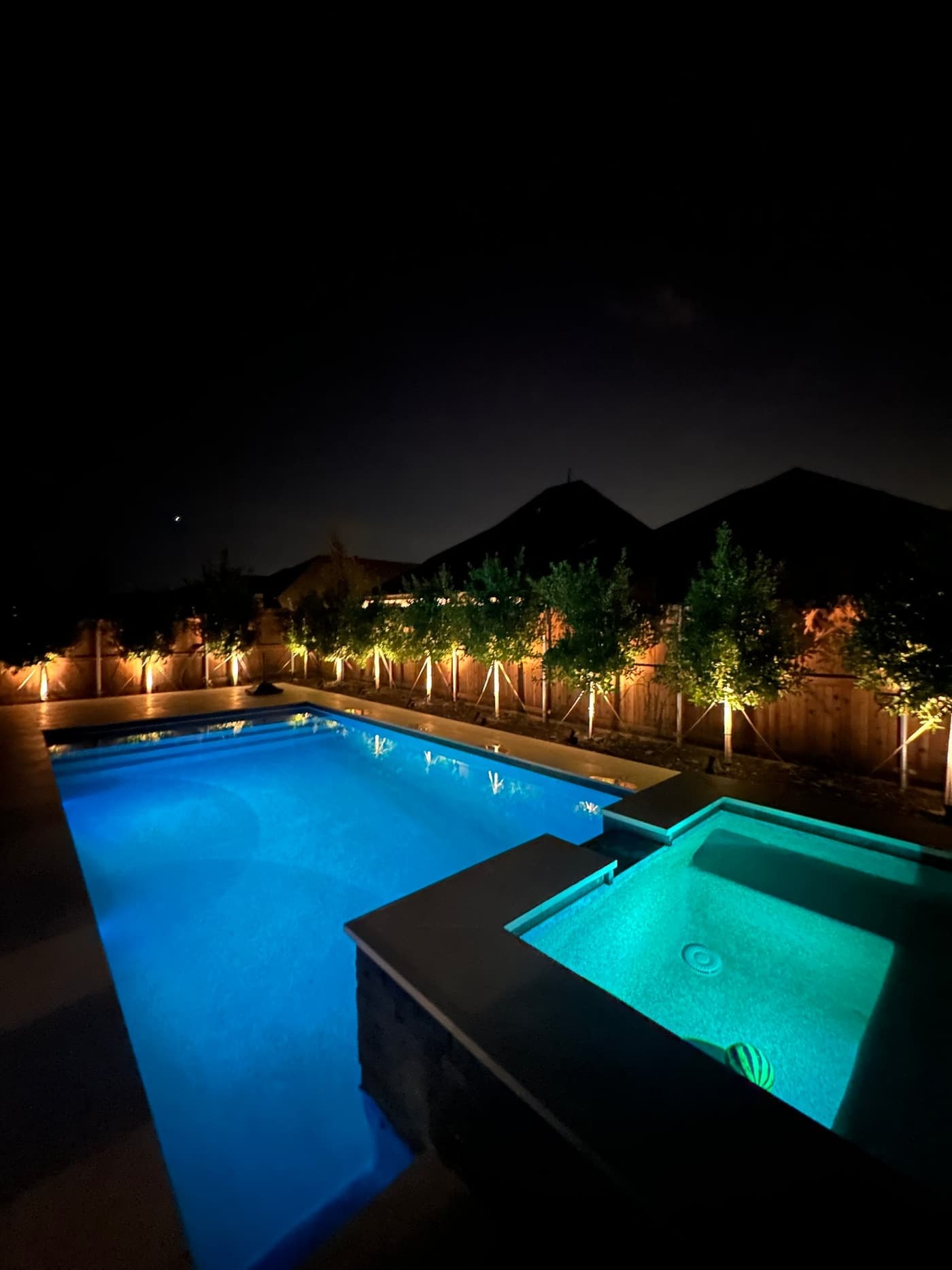
A backyard pool is not one electrical load. It is a pump, usually a heater, often a booster pump and a salt chlorine generator, an automation controller, and a set of underwater and deck lights - all sitting outdoors, within a few feet of water, on equipment that runs for hours a day in North Texas heat.
That combination is why pools get their own article in the National Electrical Code rather than being treated as ordinary outdoor wiring. The requirements that come with it - equipotential bonding, GFCI protection, receptacle placement, a maintenance disconnect, and specific rules for anything that goes underwater - exist because the failure mode here is not a tripped breaker. It is a person standing in water touching something metal.
We wire pool equipment across Celina, Prosper, Frisco, McKinney and the rest of the Dallas-Fort Worth area, on new builds alongside the pool contractor and on existing pools where something has stopped working or never passed. If you want a spa or hot tub rather than a pool, that is a different set of rules and it has its own page: hot tub and spa wiring.
What's included
- Load calculation before any circuit is designed or quoted
- Dedicated circuits for pump, heater, booster pump, salt cell and automation
- GFCI protection on pool motor circuits and pad receptacles
- Equipotential bonding grid: shell, perimeter, metal fittings, equipment and pool water
- Continuity testing across bonded components on existing pools
- Maintenance disconnect sited to code and to how the yard is actually used
- Underwater luminaire circuits, listed pool-rated transformers and wet-niche conductors
- Equipment-pad sub-panel where the layout calls for it
- Permit, coordination with your pool contractor, and inspection scheduling before cover-up
Pool Equipment Is Several Loads, Not One
Walk up to a typical Collin County equipment pad and you will find a filter pump, a heater, frequently a booster pump for the cleaner, a salt chlorine generator, an automation panel, and a low-voltage transformer for the lights. Each has its own requirements, and they are not interchangeable.
The pump is a motor load, which behaves differently from the resistive loads most of a house is made of - it draws harder on startup and it runs for hours at a stretch. The heater is either a gas unit with a modest electrical requirement for its controls and blower, or an electric heat pump with a substantial dedicated circuit of its own. The salt cell and automation controller are small but want clean, dedicated power rather than being tapped off whatever was closest.
Added together, this is usually more than people expect, and it is one of the most common reasons a house runs out of panel capacity. Where the main service has headroom but the panel is full, a small sub-panel at the equipment pad is the usual answer - it puts the breakers where the equipment is, which makes the pad far easier to troubleshoot and safer to work on than running six home runs back to a crowded panel at the house. Where the service itself is the constraint, that is an electrical panel upgrade conversation instead, and our 200-amp vs 100-amp panel guide covers how we size it. Either way we run the load calculation before quoting.
Equipotential Bonding: What It Is, and What Gets Bonded
Bonding is the single most important thing in pool electrical work, and it is the part a homeowner never sees because it is buried under the deck before the concrete goes down.
The idea is simple. Every conductive thing in and around the pool gets tied together so that no two of them can ever sit at a different electrical potential. If they are all at the same potential, there is no voltage difference for current to cross - which is what protects somebody standing in water with a hand on a metal rail.
Writing in EC&M, Vince Della Croce sets out what the code requires for permanently installed pools. The bonding conductor is solid copper no smaller than 8 AWG (rigid brass conduit or another identified corrosion-resistant metal may also be used), and the parts tied into it include:
- The pool shell, through its reinforcing steel or a copper grid. Concrete is conductive; vinyl liners and fiberglass shells are not, which changes what has to be done.
- The perimeter surface, which extends three feet horizontally from the inside wall of the pool, as well as three feet above and two feet below the maximum water level.
- Metal fittings within or attached to the pool structure, and other metal structure such as metallic wall panels.
- Metal parts of electrical equipment - pumps, heaters, pool covers - and equipment within five feet of the pool wall.
- Fixed metal parts within five feet horizontally of the pool wall or twelve feet vertically above the maximum water level: fences, gutters, window frames.
- Underwater lighting forming shells and mounting brackets, except listed low-voltage nonmetallic and no-niche systems.
- The pool water itself. Where no bonded part is in contact with the water - a liner pool, for instance - an approved corrosion-resistant conductive surface exposing at least nine square inches to the water is required.
A conductive shell bonded to a perimeter surface connects to the reinforcing steel or copper grid at a minimum of four points, uniformly spaced around the pool. In unpaved perimeter areas the conductor runs eighteen to twenty-four inches from the inside wall of the pool and four to six inches below finished grade; under paving it sits directly beneath and not more than six inches below finished grade.
Those figures come from the 2023 NEC as amended by a tentative interim amendment, and the perimeter-surface definition in particular has moved across recent editions. Your city inspects to the edition it has adopted, so we confirm the current requirement at your address rather than building to the version we learned.
Why a Tingle at the Handrail Is Never Normal
Bonding problems do not announce themselves the way a dead circuit does. The pool works. The lights come on. What people report instead is a faint tingle climbing out on a wet ladder, or a sensation at the handrail that goes away when the pump is off, or a dog that will not use the steps any more.
That is a potential difference, and it means the bonding grid is either incomplete or has lost continuity somewhere - a corroded clamp at the ladder anchor, a bonding lug that was never landed on the replacement pump, a connection to the shell that was cut during a deck repair, or an older pool that simply predates the requirement.
It is worth taking seriously rather than living with. The point of the grid is that nothing near the water is at a different potential than anything else; if you can feel a difference, the grid is not doing its job. We test for continuity across the bonded components rather than guessing, and the fix is often a single clamp or a re-landed conductor rather than a demolition project - though on older pools it is sometimes genuinely more involved, and we will tell you which one you are looking at before we start. An electrical safety inspection is a reasonable way to get the whole backyard checked at once if you are unsure what you have.
GFCI Protection and Where Receptacles Can Go
The second layer of protection is ground-fault detection, and the code is specific about where it applies. Writing in EC&M, Mike Holt sets out the requirements for permanently installed pools:
- GFCI protection is required for all pool motors rated 60 amps or less, whether they are cord-and-plug connected or hardwired. This applies to replacement pump motors too, which catches people out - swapping a failed pump is a trigger to bring the circuit up to current requirements, not a like-for-like change.
- Receptacles serving pool motors or other circulation-related loads must be GFCI protected, and must sit at least six feet from the inside walls of the pool. Receptacles for loads unrelated to circulation have the same six-foot limit.
- The pool equipment room needs at least one GFCI-protected 15- or 20-amp, 125-volt receptacle, which is the outlet you will actually use for a vacuum or a work light.
The practical version: anything on that pad is on a protected circuit, and the convenience outlet is where you can reach it without dragging a cord across wet concrete. If you also want properly protected exterior outlets elsewhere in the yard, that is outlet and switch installation.
The Maintenance Disconnect
Pool equipment other than lighting needs a maintenance disconnecting means - a way to kill power to the pad right at the pad, so nobody services a pump by trusting that somebody inside the house left the breaker alone.
Per the same EC&M guidance, the disconnect has to be readily accessible and within sight of the equipment, and located at least five feet from the pool, spa, hot tub or fountain equipment, unless it is separated from the open water by a permanently installed barrier. The distance is measured from the water's edge along the shortest path to the disconnect.
That last clause matters more than it sounds. On a tight Collin County lot where the pad is tucked against a fence a few feet from the coping, where the disconnect is allowed to go is a real design constraint rather than a formality, and it is easier to resolve on paper with the pool contractor than after the decking is poured.
Underwater Lights, Niches and Transformers
Lighting that goes in the water has its own rules, and they are strict for obvious reasons.
Transformers and power supplies have to be listed, labeled and identified for swimming pool use - a landscape lighting transformer is not a substitute. A wall-mounted underwater luminaire is installed so the top of the lens sits at least eighteen inches below the normal water level. Where a nonmetallic raceway runs to a wet-niche forming shell, it carries an 8 AWG insulated copper conductor terminated to the shell. And the forming shell has to be positioned, with enough cord, that the luminaire can be lifted out and set on the deck for servicing rather than requiring somebody to work on it underwater.
Above the water, luminaires and lighting outlets within five feet horizontally of the inside walls have to be at least twelve feet above the maximum water level, and overhead conductor clearances are governed by their own table in the code.
Most of the pool lighting we are asked about now is low-voltage LED, which is simpler and safer than the line-voltage fixtures older pools were built with, but it still has to be a listed system installed the way the listing requires. If the project also covers the rest of the yard - pathway lighting, tree uplighting, soffit and fence lighting of the kind in the photo on this page - that is landscape and outdoor lighting, and it is efficient to plan both at once while the trenches are open.
Permits, Code Editions and Working With Your Pool Builder
Pool electrical work is permitted and inspected in every city we serve, and the bonding grid in particular is inspected before it is covered - once the deck is poured, verifying it means destructive investigation. That sequencing is the single thing most worth getting right on a new build.
Pool contractors handle excavation, the shell, plumbing, decking and startup. The permanent electrical work is a licensed electrician's scope, under the framework the Texas Department of Licensing and Regulation sets and enforces. TDLR adopts the National Electrical Code as the state electrical code, and the 2026 NEC took effect on September 1, 2026 with a limited exception covering ground-fault circuit interrupter requirements on certain outdoor outlets. Cities may adopt and amend a different edition, and several of the cities we work in are inspecting to an older one - which is exactly why the bonding and GFCI details above need confirming per address rather than assumed.
We coordinate with your pool builder on timing, get the bonding and conduit in at the right stage, pull the permit and schedule the inspections in the correct order. On an existing pool - a pump replacement, a heater addition, lights that have stopped working, or a bonding question - contact us and describe it. Photos of the equipment pad and the panel usually tell us most of what we need before we come out.
What it costs
Pool electrical cost is driven by the scope rather than the pool. The factors that actually move it: how many pieces of equipment are on the pad and whether the heater is gas (small electrical load) or an electric heat pump (a substantial dedicated circuit); distance from the panel and whether a sub-panel at the pad is the better answer; trenching length and what is in the way; whether bonding is being installed new on a build versus traced and repaired on an existing pool, which is far less predictable; underwater lighting count and whether the existing niches and conduit can be reused; and permit fees, which vary by city. For North Texas labor rates generally, see our electrician cost guide. We quote after a load calculation and a look at the pad - request a free quote.
Pool Equipment Wiring — FAQ
Does a vinyl-liner or fiberglass pool still need bonding?
Yes, though what gets bonded differs. Concrete shells are conductive and are bonded through their reinforcing steel or a copper grid, with a minimum of four connection points uniformly spaced around the pool. Vinyl liners and fiberglass shells are not conductive, so the four-point shell connection does not apply - but the perimeter surface, metal fittings, equipment and fixed metal nearby are still bonded, and because no bonded part contacts the water, an approved conductive surface exposing at least nine square inches to the water is required.
Why does my pool pump keep tripping the GFCI?
Usually a failing pump motor, moisture in the motor or a junction box, or damaged conductors in the conduit to the pad. A GFCI trips on current leaking to ground, so repeated trips generally mean it is detecting something real rather than being oversensitive - it is worth diagnosing rather than resetting. Pool motors rated 60 amps or less require GFCI protection, including replacement motors, so removing the protection is not an option.
How far from the pool do the outlets and the disconnect have to be?
Receptacles must be at least six feet from the inside walls of the pool, whether they serve the circulation equipment or something else, and the equipment room needs at least one GFCI-protected 15- or 20-amp, 125-volt receptacle. The maintenance disconnect must be readily accessible, within sight of the equipment, and at least five feet from the water unless a permanently installed barrier separates it - measured from the water's edge along the shortest path.
Do you work with my pool builder?
Yes, and on a new build that coordination is the job. Pool contractors handle excavation, the shell, plumbing, decking and startup; the permanent electrical work is a licensed electrician's scope. The important sequencing is that the bonding grid and conduit go in at the right stage and get inspected before anything is covered, because verifying a bonding grid under a poured deck means breaking it up.
Do I need a permit for pool electrical work?
Yes, in every city we serve, and the bonding is inspected before it is covered. We pull the permit, register with the city where that is required, and schedule the rough and final inspections in the right order. Electrical contracting in Texas is regulated by the Texas Department of Licensing and Regulation, which adopts the National Electrical Code as the state electrical code; individual cities may adopt and amend a different edition, so we confirm which one applies at your address.
Helpful guides
Ready for a straightforward, honest quote?
Licensed & insured, owner-operated, and 5.0★ across 186 reviews. No pressure — just a clear, free quote for your home.