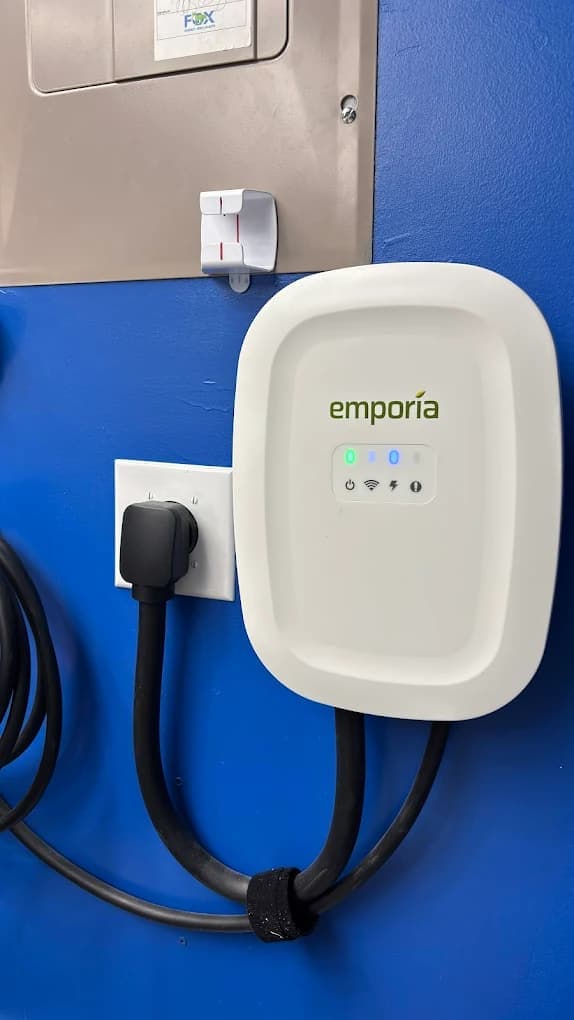
Buying an EV is the easy part. Figuring out what it actually costs to charge it at home, safely and reliably, is where most homeowners in North Texas start asking questions. The answer depends less on the charger itself and more on what your garage and electrical panel can already support.
Here's a real look at what EV charger installation typically costs across Celina, Prosper, Frisco, McKinney, and the rest of Collin and Denton County, and what pushes the price up or down.
Typical EV charger installation costs
| Scenario | Typical Price Range |
|---|---|
| Simple install, charger near existing panel | $800 – $1,300 |
| Standard install, new dedicated circuit run | $1,300 – $2,000 |
| Install requiring a panel upgrade first | $2,500 – $4,500+ |
| DFW area typical range (most homes) | $1,300 – $2,500 |
| Electrician labor (non-emergency) | $85 – $160 / hour |
These are market ranges, not a quote. The gap between the low end and high end usually comes down to one question: does your existing panel have room for another 240-volt circuit, or does it need work first?
What actually determines your price
Distance from the panel to the charger. If your electrical panel is in the garage, right next to where you'll park, the wiring run is short and simple. If the panel is on the far side of the house, or the charger needs to reach a driveway instead of a garage, that's more wire, more labor, and sometimes wall or conduit work.
Panel capacity. This is the big one. A Level 2 charger typically needs a dedicated 240-volt circuit, usually 40-50 amps. If your panel is already close to its limit — common in older homes with 100-amp service — there may not be room to add that circuit without an upgrade first.
Charger hardware. Some homeowners already own a charger and just need installation. Others want a specific brand or model, like a Tesla Wall Connector, installed. Hardware cost is separate from installation labor and varies by brand and features.
Permit and inspection. Most Texas municipalities require a permit for new circuit installations, including EV chargers. Your electrician pulls this as part of the job.
Does your panel need an upgrade first?
This is the question that determines whether your project costs $1,000 or $3,500. About 20% of homes need a panel upgrade before an EV charger can be safely installed — usually because the existing panel doesn't have the spare capacity for another high-draw 240-volt circuit.
Signs your panel might need attention first:
- Your home has a 100-amp panel (common in older North Texas homes)
- Your panel is already close to full, with few or no open breaker slots
- You're also running central AC, an electric range, and other major appliances off the same panel
- Your panel is more than 25-30 years old
If any of that sounds like your home, read our full breakdown in do I need a panel upgrade for an EV charger, or see general panel upgrade cost ranges for what that additional step typically runs.
Level 1 vs. Level 2 charging
Every EV comes with a Level 1 charging cable that plugs into a standard 120-volt outlet. It works, but it's slow — often adding only a handful of miles of range per hour, which can mean an overnight charge barely gets you back to full if you drove a lot that day.
A Level 2 charger runs on a 240-volt circuit, the same voltage as an electric dryer or range, and charges several times faster. For most people who drive an EV as a daily vehicle, Level 2 is the practical choice, which is why it's the standard for home installations.
Tesla Wall Connector vs. universal Level 2 chargers
If you drive a Tesla, you have two main hardware options: a Tesla Wall Connector or a universal Level 2 charger that works across EV brands using a standard J1772 connector (Teslas can use these with an adapter). The installation requirements — circuit sizing, panel capacity, permit — are essentially the same either way. The choice mostly comes down to hardware features, price, and whether you might switch vehicle brands down the road.
What the installation process looks like
- Evaluation. A licensed electrician checks your panel's current capacity, the distance from the panel to your desired charger location, and any code requirements for your area.
- Quote. You get a price based on your home's actual setup, not a generic estimate.
- Permit. The electrician pulls the required permit.
- Installation. The dedicated circuit is run, the charger is mounted and wired, and everything is tested.
- Inspection. The work is inspected to confirm it meets code.
A straightforward install is often done in a single day. Jobs that include a panel upgrade take longer.
Getting a number for your home
General ranges are a starting point, not a quote. Whether your install lands at $900 or closer to $3,000 depends entirely on your panel, your garage layout, and your specific EV charger. If you're in Celina, Prosper, Frisco, McKinney, Plano, Aubrey, Little Elm, or The Colony and want to know exactly what your install would cost, request a free quote and we'll evaluate your setup in person.
Sources
Frequently asked questions
How much does it cost to install an EV charger at home in North Texas?
Most home EV charger installations in North Texas run about 1,300 to 2,500 dollars. Simple installs near the panel can be less, and jobs that also require a panel upgrade can run higher. The only way to get an exact price is to have a licensed electrician evaluate your garage, your panel, and the distance to your parking spot.
Do I need a Level 2 charger, or is a regular outlet enough?
A standard outlet, known as Level 1 charging, works but is slow, often adding only a few miles of range per hour. A Level 2 charger uses a 240-volt circuit, similar to an electric dryer, and charges significantly faster, which is why most homeowners who drive an EV regularly choose to install one.
Will my electrical panel handle an EV charger?
It depends on your panel's age, amperage, and how much of its capacity is already in use. Roughly 1 in 5 homes need a panel upgrade before a Level 2 charger can be safely added. A licensed electrician can check your panel's available capacity before installation.
Is a Tesla Wall Connector different from a standard Level 2 charger?
A Tesla Wall Connector is Tesla's own Level 2 charging hardware, built specifically for Tesla vehicles, though newer versions also support other EVs with an adapter. Installation requirements, like circuit sizing and panel capacity, are similar to installing any other Level 2 charger.
Do I need a permit to install an EV charger?
In most Texas jurisdictions, yes, an electrical permit is required for EV charger circuits, and it's pulled by the licensed electrician doing the work, not the homeowner.